
MeRT® Therapy
MeRT® is not currently cleared by the FDA.
Clinical trials are underway in support of FDA clearance for the treatment of PTSD.
Personalized Brain Stimulation for Lasting Change
MeRT (Magnetic e‑Resonance Therapy) is an advanced, personalized form of TMS that uses your own brainwave data to guide treatment. It’s a non‑invasive, drug‑free option designed to help the brain communicate more efficiently so symptoms of conditions like depression, anxiety, PTSD, TBI, autism, and more can improve.
How MeRT® Works
Step 1: Comprehensive Evaluation
Your MeRT journey starts with a thorough evaluation. We review your medical and mental‑health history, your current symptoms, and what you hope to achieve so we can determine whether MeRT is an appropriate option and how to tailor care around your needs.
Step 2: Brain Mapping With EEG
Next, we perform a detailed brain mapping using EEG (electroencephalogram). During this 10‑minute test, you sit comfortably with your eyes closed while sensors on a cap record the natural electrical activity of your brain.
From this recording, we look closely at:
- How efficiently your brain’s networks are communicatin
- The function of your Default Mode Network (DMN), a key network involved in mood, memory, and self‑awareness
- Your Individual Alpha Frequency (IAF), the specific rhythm at which your brain tends to operate most efficiently
We then compare your EEG data to large normative databases to see where your brain is working well and where there are disruptions in communication that might be contributing to your symptoms.
Step 3: Personalized Treatment Plan
Using your EEG results, specialized software generates a personalized MeRT protocol. Rather than using a one‑size‑fits‑all frequency and location, your plan specifies:
- Exactly where on the scalp to stimulate
- The precise frequency (typically within your alpha range) that best matches your own brain rhythm
- The stimulation intensity that is high enough to be effective yet remains comfortable
This means your treatment is literally guided by your own brain activity instead of generalized settings.
Step 4: MeRT® Treatment Sessions
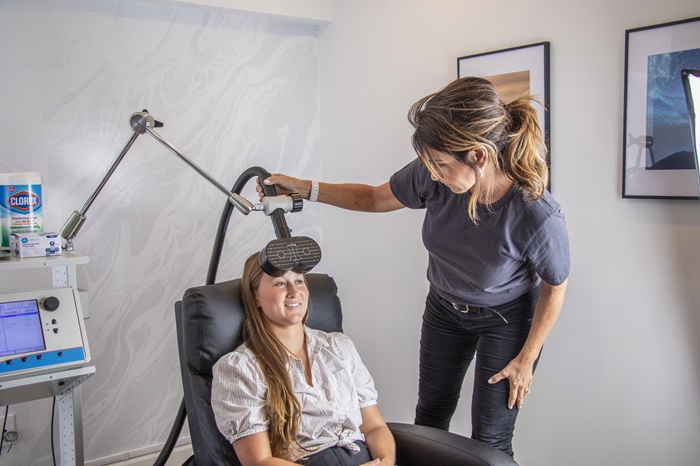
MeRT treatments are delivered with an FDA‑cleared TMS device in our office. A typical session lasts about 30 minutes. Most patients come 5 days per week for an initial series of several weeks; we will discuss a recommended schedule with you after your evaluation.
During a session:
- You sit in a comfortable chair in a quiet room
- A treatment coil is positioned over targeted brain regions
- You hear clicking sounds and feel a tapping sensation on your scalp during the brief stimulation periods
- We usually ask you to rest with your eyes closed during the 6‑second trains of stimulation so your brain is in a calm, awake state
You’re awake the entire time, there is no anesthesia, and you can return to normal activities right after your session.
Step 5: Ongoing Monitoring and Adjustments
As treatment progresses, we periodically repeat EEG measurements to see how your brain is responding. This allows us to:
- Track changes in your brainwave patterns
- Adjust your treatment protocol as your networks begin to synchronize more effectively
- Make sure your plan stays aligned with your clinical progress
Because MeRT is personalized, your protocol may evolve over time as your brain changes.
How MeRT® Affects the Brain
The brain is often compared to a symphony. When all the instruments (brain cells) play in sync, the music (your thinking, mood, and behavior) is clear and harmonious. When some instruments fall out of rhythm, the result is noise, confusion, or distress.
Many conditions—such as depression, anxiety, PTSD, TBI, ADHD, OCD, and autism—are associated with disruptions in brain networks. Instead of a stable, efficient alpha rhythm, we may see too much slow activity in some areas, excessive fast activity in others, or poor coordination between key regions like the prefrontal cortex and deeper structures in the Default Mode Network.
MeRT uses gentle, magnetic pulses tuned to your own Individual Alpha Frequency to “nudge” misfiring neurons back toward more organized, synchronous patterns. Over a series of sessions, this neuromodulation can help:
- Improve network coherence and communication
Support healthier mood regulation and stress response - Enhance attention, cognitive performance, and emotional flexibility
- Promote deeper, more restorative sleep
Because MeRT works at the level of brain networks, it can complement therapy, medications, and lifestyle interventions by addressing part of the underlying brain‑based contribution to symptoms.
Conditions We Treat With MeRT®
MeRT is an off‑label, non‑invasive treatment approach that has been used to support a wide range of conditions. Individual results vary, and not everyone will respond in the same way, but research and clinical experience suggest potential benefits in several key areas.
Depression and Treatment‑Resistant Depression
Standard TMS is FDA‑cleared for treatment‑resistant depression, and MeRT builds on this technology by personalizing stimulation to your EEG. For many people living with persistent depression, MeRT aims to:
- Normalize disrupted frontal networks involved in mood regulation
- Reduce symptoms such as low mood, lack of motivation, and cognitive fog
- Work alongside therapy and medication to support a more stable emotional baseline
Anxiety and Panic Symptoms
Chronic anxiety is often linked to hyperarousal and overactive threat circuits. With MeRT, we target abnormal patterns in brain networks that process worry, stress, and bodily sensations. The goal is to:
- Calm overactive circuits
- Reduce physical tension and “constant on‑edge” feelings
- Support clearer thinking and improved emotional resilience
Post‑Traumatic Stress Disorder (PTSD)
Trauma can profoundly disrupt communication within and between brain networks responsible for memory, threat detection, and self‑regulation. MeRT protocols for PTSD focus on:
- Frontal and midline areas involved in the Default Mode Network
- Abnormal patterns linked to hypervigilance, intrusive memories, and emotional numbing
Early studies have shown promising reductions in PTSD symptom scores when stimulation is personalized to a person’s own alpha rhythm, and MeRT has received Breakthrough Device recognition from the FDA as an emerging option for PTSD.
Traumatic Brain Injury (TBI) and Post‑Concussive Syndrome
Even mild brain injuries can leave lasting changes in how brain cells communicate. People may experience headaches, brain fog, mood swings, sleep problems, and difficulty concentrating for months or longer.
MeRT uses EEG‑guided stimulation to:
- Identify and target areas of slowed or disorganized activity
- Support the restoration of more efficient network functioning
- Help reduce cognitive fatigue and improve clarity, mood, and sleep in some patients
Autism Spectrum Disorder
Children and adults on the autism spectrum often show distinctive EEG patterns, including disorganized activity in frontal regions that support language, social interaction, and flexible behavior. MeRT does not “cure” autism, but it may:
- Encourage more coherent brain rhythms in key networks
- Support improvements in sleep, attention, and regulation
- In some cases, be associated with gains in communication and engagement
MeRT for autism is off‑label and highly individualized. We work closely with families to set realistic expectations and to integrate treatment alongside therapies such as ABA, speech, and occupational therapy.
ADHD and Attention Problems
ADHD is linked to dysregulation in brain circuits that control attention, impulse regulation, and executive functioning. By personalizing stimulation to your EEG, MeRT may help:
- Optimize frontal network function
- Reduce distractibility and mental “restlessness”
- Support sustained focus and follow‑through
OCD and Related Conditions
Obsessive‑compulsive disorder involves rigid, repetitive patterns at both the psychological and neural levels. While more research is still emerging, MeRT is being explored as an off‑label option to:
- Modulate circuits that link intrusive thoughts and compulsive behaviors
- Reduce the intensity and frequency of obsessive loops in some individuals
Sleep Problems and Insomnia
Quality sleep is crucial for healing and brain performance. Disorganized brainwave activity can interfere with a healthy sleep‑wake rhythm. Because MeRT focuses on restoring more stable, efficient brain rhythms, many patients report:
- Falling asleep more easily
- Fewer nighttime awakenings
- More refreshing, restorative sleep
We also coach you on habits—like consistent morning light exposure—that support your brain’s natural circadian rhythm and enhance your response to treatment.
Why Choose Our Practice for MeRT®?
Choosing where to receive MeRT matters. The skill of the clinical team, the quality of brain mapping, and the care you receive throughout treatment all impact your experience and outcomes.
Experienced Clinicians Who Know the Brain
Our MeRT program is led by clinicians with deep experience in mental health and brain‑based conditions. Our team includes:
- Licensed mental‑health professionals who specialize in conditions such as depression, anxiety, PTSD, TBI, ADHD, OCD, and autism
- Providers trained specifically in neuromodulation and EEG‑guided protocols
- Clinicians who understand how to integrate MeRT with therapy, medication management, and other treatments so you receive comprehensive, coordinated care
Each provider brings a blend of scientific rigor and human warmth. We take time to listen, educate, and partner with you in every decision.
Highly Trained MeRT and EEG Technicians
Your experience in the treatment chair is handled by neurotechnicians who are specifically trained in:
- EEG acquisition and artifact troubleshooting
- Precise coil placement using the standard 10–20 system
- Safe, accurate delivery of MeRT protocols under clinician supervision
Our technicians complete structured initial training and ongoing annual education to stay current with best practices. This attention to detail helps ensure your sessions are consistent, comfortable, and technically precise.
Advanced Technology and Data‑Driven Protocols
We use advanced EEG technology and specialized software to create your personalized MeRT plan. This allows us to:
- Compare your brain activity to large, normative EEG databases
- Identify specific disruptions in your Default Mode Network and other circuits
- Design stimulation parameters that align with your own Individual Alpha Frequency rather than generic settings
Our philosophy is simple: you wouldn’t treat a broken bone without imaging; likewise, we believe brain‑based care should begin with objective measurements whenever possible.
Patient‑Centered, Safety‑Focused Care
Safety and comfort are priorities at every step. Before starting MeRT, we carefully review your medical history to identify factors such as seizure risk, bipolar disorder, implanted devices, or other considerations that may affect your candidacy.
During treatment, potential side effects are typically mild and may include:
- Temporary scalp discomfort, headache, or neck tension
- Brief ringing in the ears (we provide hearing protection as needed)
- Occasionally, a short‑term increase in emotional sensitivity as the brain begins to shift
The overall risk of seizure with TMS‑based treatments is very low, especially in individuals without a seizure history. We monitor you closely during each session, encourage you to report any new symptoms, and remain available to adjust your plan if needed.
We also support you with guidance on sleep, nutrition, and daily habits so your brain has the best possible environment for change.
Evidence and Research: What We Know So Far
MeRT is built on decades of research into repetitive transcranial magnetic stimulation (rTMS), which is well‑studied for conditions like treatment‑resistant depression. What’s new is the degree of personalization.
While research into personalized MeRT protocols is ongoing, early findings are promising:
Studies of MeRT‑type approaches in PTSD
have shown meaningful reductions on standardized symptom scales, along with EEG changes that suggest more normalized brain rhythms.
Retrospective reviews of alpha‑guided stimulation
in military and civilian populations have reported improvements in PTSD, depression, and cognitive symptoms for many patients.
Clinical research in TBI and autism
has documented shifts in EEG patterns and reported improvements in areas such as sleep, behavior, and cognitive functioning in some individuals.
Large reviews of TMS
confirm that this technology is generally safe and can be effective, particularly for treatment‑resistant depression, giving a strong foundation for more personalized approaches like MeRT.
At the same time, it is important to be transparent: MeRT is used off‑label for many conditions, larger trials are still underway, and no outcome can be guaranteed. Our commitment is to share what we know, monitor your progress carefully, and adjust your plan based on both the data and your lived experience.
What to Expect and Next Steps
You may be a good candidate for MeRT if you:
- Have ongoing symptoms of depression, anxiety, PTSD, TBI/post‑concussion, ADHD, OCD, autism‑related challenges, or chronic sleep problems
- Prefer a non‑drug, non‑invasive approach or want to enhance the effects of your current treatments
- Are willing and able to attend frequent sessions over several weeks
- Do not have certain implantable devices or medical conditions that would make TMS‑based therapy unsafe
In your consultation, we will review your history, medications, and goals in detail to determine fit and answer all your questions.
Common Questions
Will I feel anything during treatment?
Most people feel a tapping sensation on the scalp and hear clicking sounds from the device. Some describe a brief, mild discomfort at the start that usually fades as they get used to the sessions.
Can I stay on my medications?
We typically ask you not to make any medication changes during your initial MeRT series unless your prescribing provider recommends it. We will coordinate care and ensure all your providers are informed.
How long do results last?
Response and durability vary. Many people notice changes building over the course of treatment. Some choose periodic “maintenance” sessions if symptoms start to return over time.
Is MeRT a replacement for therapy or medication?
Not necessarily. For many patients, MeRT works best as part of a broader plan that can include therapy, medication, lifestyle changes, and support from family and community.
Getting Started
If you’re living with persistent symptoms despite your best efforts, there is a different way to approach brain‑based conditions. MeRT offers a personalized, data‑driven path that looks directly at how your brain is functioning and seeks to gently guide it back toward healthier patterns.
We’d be honored to help you explore whether this treatment is right for you.