
Core Stability, Hip Strength, and Nerve Mobility
The Three Pillars of Lasting Relief for Lumbar Radiculopathy
Core stability, hip strength, and nerve mobility work together like a three‑legged stool: if one is weak, your lower back and leg symptoms become harder to control, but when all three are addressed, lasting relief becomes much more realistic. This post walks through what each pillar is, why it matters for lumbar radiculopathy and sciatica‑type pain, and how to start safely.
Why these three pillars matter for lumbar radiculopathy
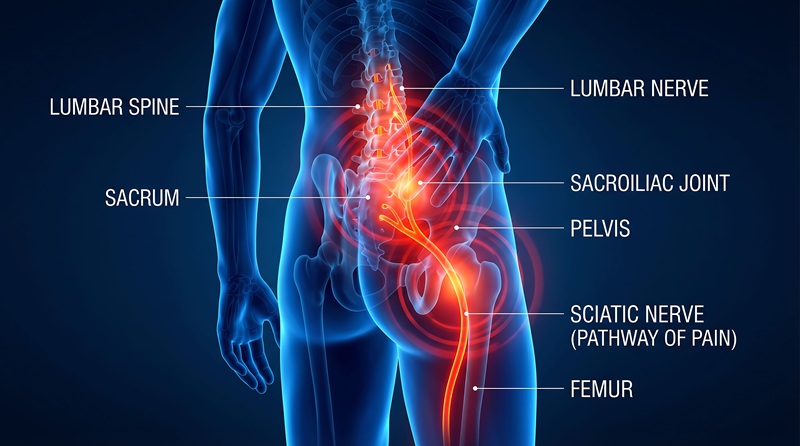
Lumbar radiculopathy happens when a nerve root in your lower back is irritated or compressed, often by a disc herniation, spinal stenosis, or age‑related changes in the spine. That irritation can cause pain, numbness, tingling, or weakness that travels from your lower back into your buttock, thigh, calf, or foot.
When your core is weak, your spine has less support, so everyday movements put more stress on the irritated area. When your hips are weak or tight, your body compensates with awkward patterns that further overload the low back. And when the nerve itself is stiff or hypersensitive, even small movements can “tug” on it and trigger symptoms. Together, this is why you may feel like everything sets your leg off—sitting, standing, walking, or bending.
Focusing systematically on core stability, hip strength, and nerve mobility reduces the mechanical stress on the irritated nerve and improves how your back moves, giving the nerve a better environment to calm down. You’re not just chasing pain; you’re changing the conditions that keep that pain alive.
Pillar 1: Core stability
What “core” really means
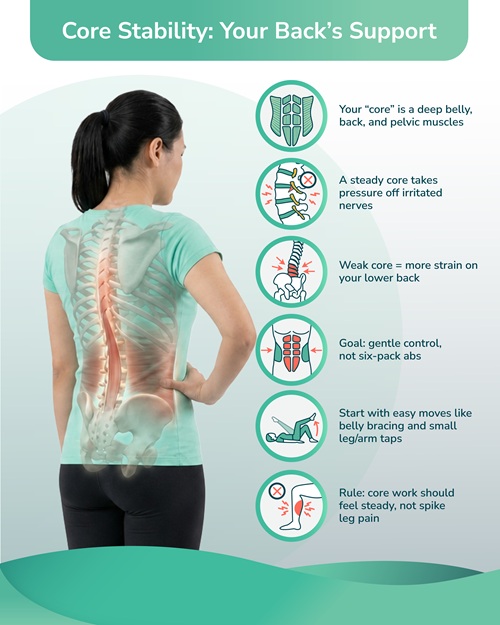
“Core” is more than “abs.” It includes the deep muscles of your abdomen, back, pelvic floor, and even your diaphragm. These muscles work together to create a stable cylinder around your spine, helping you bend, lift, twist, and stand upright without dumping all the load into a few overworked joints or discs.
With lumbar radiculopathy, people often brace with their outer muscles (like rectus abdominis and spinal erectors) and still feel unstable because the deep stabilizers are not doing their share. The goal is to retrain those deeper muscles to turn on gently and consistently in daily life, not to build a six‑pack.
Signs your core stability needs attention
- Your back feels tired or achy after sitting or standing for short periods.
- You notice yourself constantly shifting in your chair to “find” a comfortable position.
- Simple tasks like rolling in bed, getting out of a car, or putting on pants feel clumsy or provoke symptoms.
Gentle starter exercises (conceptual only)
Always check with your provider before starting new exercises, especially with nerve pain. Here are the kinds of movements often used as a starting point:
- Abdominal bracing in hooklying: Lying on your back with knees bent, gently tighten your lower belly as if zipping up snug jeans, without holding your breath or tilting your pelvis. Hold a few seconds, then relax.
- Bent‑knee fallouts: In the same position, let one knee slowly open out to the side a few inches while keeping your pelvis level and your core gently engaged, then return and switch sides.
- Dead bug variations: With your back supported, alternating arm and leg reaches while keeping your trunk steady, starting very small and pain‑free.
The right dosage is low and controlled. You should feel gentle muscle effort, not a flare of leg pain. If symptoms increase sharply or linger afterward, the plan needs to be modified.
Pillar 2: Hip strength
Why the hips are so important
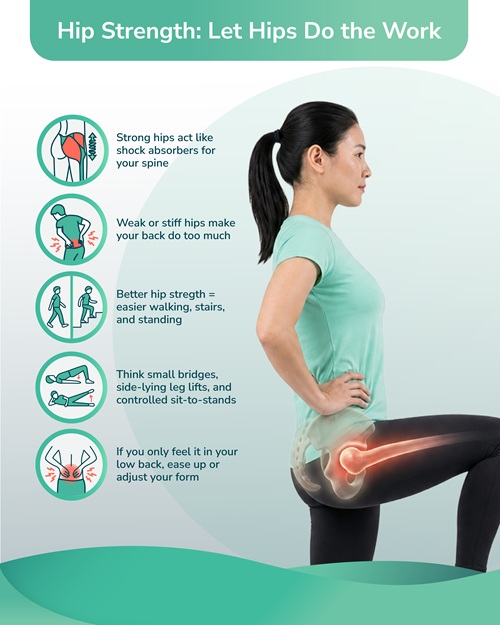
Your hips are the major “power joints” of your lower body. When they are strong and mobile, they absorb and generate the bulk of the force when you stand up, go up stairs, squat, or bend. When they are weak, stiff, or poorly coordinated, your body borrows motion from the lower back. That extra motion and load can irritate an already sensitive nerve root.
Certain hip muscles are especially important: the gluteus maximus (hip extension), gluteus medius and minimus (hip abduction and side‑to‑side control), and the deep rotators under the glutes. When these are doing their job, your pelvis stays more level, your knees track better, and your spine doesn’t have to twist and tilt as much with every step.
Common patterns in people with lumbar radiculopathy
- The glutes are underactive, while the low‑back muscles do too much.
- The hip flexors and piriformis may be tight or overworking to “protect” the area.
- Walking may show a slight limp, trunk lean, or short stride on the affected side.
Hip‑focused strengthening ideas
Again, think gentle and controlled, especially early on:
- Bridges: Lying on your back with knees bent, press through your heels to lift your hips a few inches, feeling the work in the buttocks more than the low back. Hold briefly, then lower with control.
- Side‑lying hip abduction: Lying on your side, slowly lift the top leg straight up a small amount, keeping your trunk steady and toes facing forward or slightly down.
- Sit‑to‑stands: Using a higher chair at first, practice standing up and sitting down without using your hands, focusing on pushing from your hips and heels, not your back.
When done properly, these exercises shift the workload from your spine into your hips. Over time, that can reduce irritation at the nerve root and support more confident movement.
Pillar 3: Nerve mobility
What is “nerve mobility”?
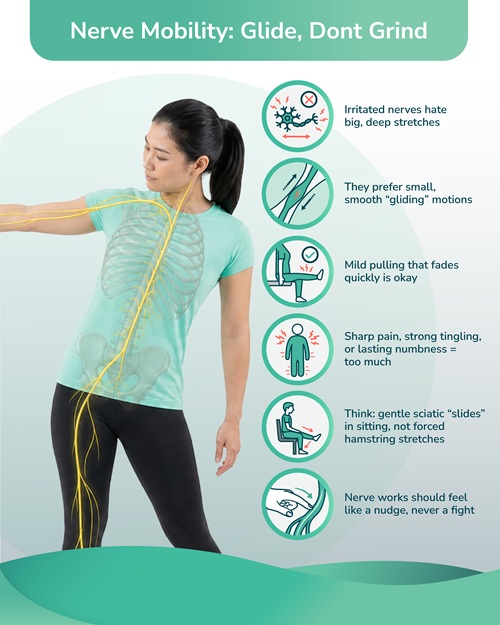
Unlike muscles, nerves are not meant to stretch aggressively, but they do need to glide smoothly through surrounding tissues. After an injury, disc issue, or prolonged inflammation, the nerve can become sensitive and may not slide as freely when you bend or straighten your leg or back. That loss of glide can create a “pulling” or electric sensation down the leg even with small movements.
Nerve mobility work—often called “nerve glides” or “neural flossing”—aims to gently move the nerve through its pathway without holding it in a stretched, aggravated position. The emphasis is on rhythm and comfort, not intensity.
What nerve‑friendly movement looks like
A classic example is a sciatic nerve glide in sitting:
- You sit tall, gently extend one knee, and at the same time point the toes up while slightly bending the neck.
- Then you reverse: bend the knee and point the toes down while returning the neck to neutral.
Notice that at no point are you yanking the leg up and holding a deep stretch. You are instead alternately “slackening” and “tensioning” parts of the nerve path in a controlled way. If the symptom is a mild, brief tug that eases when you return to the start position, that can be acceptable. Sharp pain, strong tingling, or symptoms that linger or worsen after the set are a sign to back off.
Why timing and dosage matter
Nerve tissue, when irritated, is like a sunburn: too much friction or stretching makes it worse, even if the movement is “good” in theory. Early in recovery, you may tolerate only a few very gentle repetitions once a day. As symptoms calm, you and your provider can gradually add more reps or positions. The key is to respect irritability: progress should feel like a slight expansion of what you can do, not a constant battle with flares.
Putting the three pillars together

Working each pillar in isolation is helpful, but the real power comes from integration—combining core, hip, and nerve‑friendly patterns into how you move in daily life.
For example, consider bending to pick something up from the floor:
- Your core provides a gentle brace so your spine does not collapse into an extreme rounded or twisted position.
- Your hips hinge back, letting the powerful glutes and thighs do most of the work rather than your lower back.
- Your nerve mobility work helps your leg tolerate the changes in tension as you bend and straighten, so that one quick movement does not set off a flare.
Over time, you want these patterns to show up in:
- Getting in and out of chairs, cars, and bed.
- Lifting groceries, laundry, or kids.
- Sitting at your desk, walking, and climbing stairs.
Instead of thinking in terms of “good exercises” and “bad exercises,” it can be more helpful to think in terms of movement quality: is your spine supported, are your hips contributing, and are you respecting your nerve’s current tolerance?
Progression and realistic expectations
Most people want to know, “How long will it take?” While timelines vary, there are some general phases many experience:
- Early phase (0–4 weeks): Focus is on pain control, finding tolerable positions, and very gentle core activation, hip engagement, and nerve glides. The goal is to decrease irritability, not “get strong” overnight.
- Middle phase (4–12 weeks): As symptoms become more predictable, strengthening and mobility can progress: more repetitions, more positions (like standing work), and slightly higher loads that still respect symptoms. Many people notice they can sit, walk, or work longer before pain appears.
- Later phase (3 months and beyond): The emphasis shifts to resilience—building the capacity to handle more demanding tasks, hobbies, and exercise without flare‑ups. This may include more dynamic core work, single‑leg hip exercises, and higher‑level functional training.
Setbacks are normal. A long car ride, an awkward lift, or a high‑stress week can stir things up. That does not mean you are “back to square one.” It usually means the system was temporarily overloaded. Having a clear plan built on these three pillars makes it easier to dial intensity down or up without panicking.
Lifestyle support for the three pillars
Beyond exercise, several everyday habits can support these pillars:
- Posture breaks: If you sit or stand for work, changing positions regularly (every 20–30 minutes) is often more important than holding a “perfect” posture. Small walks and gentle extensions or hip movements can calm stiffness.
- Sleep setup: Using a pillow between your knees when side‑lying, or under your knees when on your back, reduces strain on the low back and hips so healing tissue is less irritated overnight.
- Activity pacing: Breaking tasks into smaller chunks with short breaks can keep your symptoms more stable than “saving everything” for a long, exhausting effort.
- Stress and breathing: Stress increases muscle tension and pain sensitivity. Practicing slow, diaphragmatic breathing helps your deep core and calms your nervous system at the same time.
These choices will not replace targeted exercise, but they create a friendlier environment for healing and make your strengthening and nerve‑mobility work more effective.
FAQs
1. Is it safe to exercise if I have lumbar radiculopathy or sciatica?
In many cases, yes, some level of movement is not only safe but beneficial—as long as it is guided appropriately, respects your symptoms, and avoids red‑flag signs like severe, rapidly worsening weakness or loss of bowel or bladder control. If you have any of those red‑flag symptoms, you should seek urgent medical care. Otherwise, a tailored plan that starts gently and progresses gradually is often part of best‑practice care.
2. Won’t core exercises make my back hurt more?
If your core routine is made up of aggressive sit‑ups, crunches, or long planks right out of the gate, it can aggravate symptoms. The approach we are talking about emphasizes deep, low‑intensity activation in comfortable positions, such as lying on your back or side. Done correctly, people often feel more supported and less fragile, not more irritated. If any exercise increases leg symptoms significantly or leaves you worse for hours afterward, it should be modified or paused.
3. How do I know if a nerve glide is too much?
Mild, brief pulling or a very light reproduction of your symptoms that fades quickly when you return to the start position is usually acceptable. Strong, sharp pain, intense electric sensations, or numbness that lingers or spreads are signs that the nerve is being overloaded. In that case, you might reduce the range of motion, do fewer repetitions, or change position—or wait and revisit with your provider’s guidance. Nerve‑mobility work should feel like gentle persuasion, not a test of toughness.
4. Can I just focus on stretching and skip strengthening?
Stretching can feel good in the short term, especially for tight hips or hamstrings, but on its own it rarely addresses the reason your spine and nerves are under stress. Strength and control in your core and hips are what change how forces move through your body with every step, sit, and lift. Think of stretching as one tool in a larger toolkit rather than the entire solution.
5. How often should I do these exercises?
Frequency depends on your current symptom level and your program’s intensity. In the early phase, people often do gentle core activations and nerve glides once or twice a day in small sets, while hip strengthening might be done every other day to allow recovery. As you progress, sessions may become slightly longer and less frequent, similar to a normal strength program. The most important rule is to watch your 24‑hour response: you want to feel “worked but okay,” not significantly worse later that day or the next.
6. Will this approach replace the need for injections or surgery?
Some people improve significantly with a structured conservative program and never need injections or surgery. Others still benefit from medical procedures if symptoms remain severe, disabling, or progressive despite good rehab. Core stability, hip strength, and nerve mobility are valuable either way: they can reduce the need for more invasive options, boost the results of procedures, and support long‑term function after any intervention. Your provider can help you understand where you are on that spectrum.
7. How long until I feel real improvement?
Some feel small changes (like easier walking or sitting) within a couple of weeks of consistent, appropriate movement. For others, especially with more chronic or severe nerve irritation, progress may be slower and more gradual over several months. Rather than focusing only on pain scores, watch for wins like better sleep, more stable moods, fewer flare‑ups, and greater confidence in daily tasks. These are signs that the system is healing, even if some symptoms remain.