
Dive Into Adhesive Capsulitis (Frozen Shoulder)
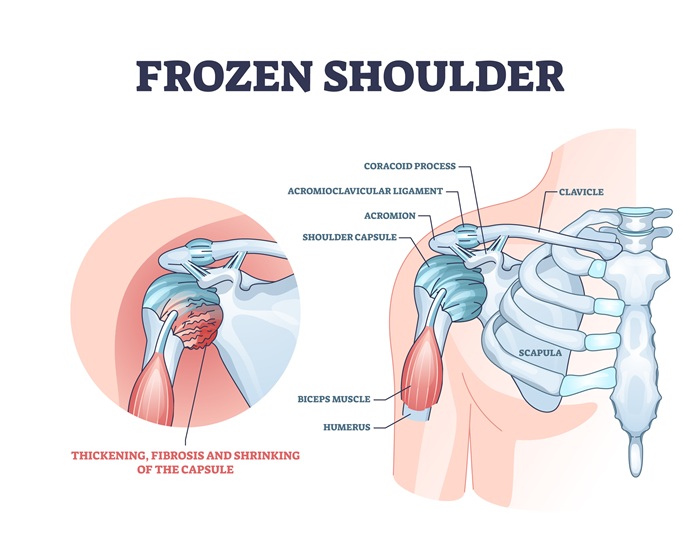
Navigating the Capsule: Anatomy and Pathology of Frozen Shoulder
Frozen shoulder, medically termed adhesive capsulitis, is a condition that brings the shoulder joint to a standstill—making familiar movements stiff, painful, and often emotionally draining. At its root, the problem lies within the joint capsule: a soft, flexible envelope surrounding the ball-and-socket joint. In adhesive capsulitis, this capsule becomes inflamed, then gradually thickens and contracts, trapping the ball of the humerus tightly against the joint and forming scar-like “adhesions”.
What does the capsule do?
- Normally, it stretches to accommodate full arm motion: reaching overhead, twisting behind your back, or even simple tasks like putting on a shirt.
- When it tightens and inflames, motion narrows—initially from pain, later simply because the capsule does not budge.
Notably, both passive and active range of motion become profoundly limited, especially for external rotation and abduction.

The Chain of Events: What Causes Frozen Shoulder?
Frozen shoulder can affect anyone, but certain groups are especially vulnerable. It may develop spontaneously or follow injury, surgery, or periods of immobilization. Its causes include:
- Primary (Idiopathic) Adhesive Capsulitis: Arises with no clear single event, often related to underlying metabolic or immune system factors.
- Diabetes and thyroid disease are strongly linked to frozen shoulder, raising risk several-fold.
- Secondary Adhesive Capsulitis: Follows trauma, surgery, fracture, or immobilization where the shoulder was not moved for weeks.
Other risk factors:
- Age (most often between 40–65 years)
- Female gender
- Prior shoulder injuries or surgeries
- Rotator cuff pathology, bursitis, or arthritis
- Systemic illness (Parkinson’s disease, heart disease)
- Prolonged inactivity or immobilization after injury
Frozen shoulder is not usually related to strenuous activity or “wear and tear”—it is a deeper process, centered in the joint capsule itself.

Stage-Specific Symptoms: Reading Your Shoulder’s Story
Frozen shoulder unfolds in three classic phases, each with distinct symptoms and challenges:
1. The “Freezing” Phase – Searing Pain Meets Stiffness
- Duration: 2–9 months
- Symptoms: Gradual, persistent shoulder pain (especially at night or with small movements) and slowly increasing stiffness.
- Early loss of motion—raising your arm, reaching behind you—becomes harder by the week.
- Pain is often severe, sharp with movement, and interferes with sleep or daily activity.
2. The “Frozen” Phase – Stiffness Dominates
- Duration: 4–12 months
- Symptoms: Pain begins to lessen, but rigidity becomes overwhelming. The joint moves only minimally outside its “safe zone.” Day-to-day tasks may be impossible, and both active and passive range are strictly reduced.
3. The “Thawing” Phase – Slow Return to Motion
- Duration: Months to years
- Symptoms: Pain fades and movement gradually returns, often one degree at a time. The capsule’s scar tissue unwinds, allowing increased freedom. Recovery can be slow and incomplete without targeted care.
It’s important to note: progress is not always symmetrical, and some patients experience lingering stiffness or pain well beyond the typical timeline.
Meet Our Specialists

Trung Ha, MD

Raphael Ye, DO

Yasmin Fatemi, MD

Justin O’Brien, MD

Brian Lee, DC

Diagnosis: Pinpointing Frozen Shoulder With Precision
An accurate, phase-specific diagnosis is critical. Holistiq Health’s clinical team uses a thorough and empathetic exam:
- History: Onset and progression of symptoms, associated medical conditions, injury history, recent surgery or immobilization.
- Physical exam:
- Profoundly limited passive and active range of motion—especially external rotation and abduction.
- The shoulder may move only minimally, even when the provider attempts to manipulate it.
- Pain with testing maneuvers, often at the end-range.
- Key differentiators: Loss of motion occurs in all directions, distinguishing adhesive capsulitis from isolated rotator cuff tears or tendinitis.
Imaging studies:
- X-rays: To rule out arthritis, fracture, or other structural causes—but not diagnostic of frozen shoulder.
- Ultrasound or MRI: Used if diagnosis is uncertain or to exclude rotator cuff tears, inflammatory arthritis, or bursitis.
Rarely, other conditions (infection, neurological disorders) can mimic frozen shoulder—careful assessment matters.
Holistiq Health’s Unique Non-Surgical Recovery Blueprint
Most frozen shoulders resolve over time, but symptoms can persist for months or even years without intervention. At Holistiq, multidisciplinary and patient-tailored strategies unlock motion and reduce pain with maximum support and minimal disruption.
1. Pain Management for Early Relief
- NSAIDs (ibuprofen/naproxen) and acetaminophen reduce discomfort in the “freezing” stage.
- Ice and heat: Decrease inflammation and promote blood flow as needed.
- Corticosteroid injections: Strong evidence for short-term pain reduction and modest improvement in range. Ultrasound-guided injections boost targeting safety.
- Hydrodilatation: Injection of saline (sometimes with steroid) to stretch the capsule in select cases, shown to accelerate early pain relief and flexibility.
2. Anti-Inflammatory Nutrition for Holistic Healing
- Nutrition plans rich in anti-inflammatory foods—greens, berries, fish, whole grains—support tissue healing and lower systemic inflammation.
- Metabolic optimization: Especially important for patients with diabetes or thyroid disorders. Blood sugar and hormone control assist in quicker, fuller recovery.
3. Physical Therapy: Motion Restoration and Capsule Mobilization
- The foundation of frozen shoulder care, tailored exercise regimens move patients through each disease stage:
- Early focus: Gentle, pain-free range-of-motion maintenance.
- Frozen phase: Structured, progressive stretching (manual therapy, self-directed exercises, use of heat before stretching).
- Therapy includes:
- Passive and active stretches
- Joint mobilization
- Manual therapy focused on capsular fibrosis
- Home exercise program with daily flexibility and position-specific routines
- Physical therapists continually reassess pain and progress, avoiding forceful over-stretching that could worsen symptoms.
4. Chiropractic and Manual Therapies
- Mobilization and targeted adjustments can help the capsule “thaw.”
- Soft tissue release, massage, and myofascial techniques address compensatory muscle tension and pain.
5. Shockwave Therapy and Modern Modalities
For persistent pain and fibrosis, shockwave treatment, ultrasound, and electrical stimulation (combined with stretching/mobility) may help restore blood flow and capsule pliability.
6. Regenerative Medicine
Platelet-rich plasma (PRP) or advanced biologics remain investigational, but may enhance healing in stubborn or complex cases, especially for those not responding to core therapies.
7. Multidisciplinary Care
Holistiq coordinates closely with endocrinologists for diabetes and thyroid management, primary care for comorbidities, and mental health specialists for pain coping and mood support.
8. Insurance and Accessibility
All major health insurance accepted—ensuring that patients receive comprehensive care without financial stress.

The Road Home: Prognosis, Timelines, and Preventive Wisdom
Frozen shoulder is a marathon, not a sprint—but timely care makes all the difference.
- Most patients recover substantially in 12–24 months; near-complete recovery is possible, but persistent mild limitations can remain, especially if intervention is delayed.
- Early motion after surgery or injury prevents capsule “locking.”
- Long-term prevention:
- Stay active.
- Stretch and mobilize daily.
- Control metabolic conditions.
- Seek help at first signs of stiffness—not when function is deeply impaired.
Patients who embrace therapy, exercise, and metabolic care recover faster and more fully than those hoping for spontaneous improvement.
Frozen Shoulder Treatment: Surgical Thresholds
Rarely, surgery is needed. If after 6–9 months of structured conservative care (physical therapy, injections, etc.) motion remains severely restricted and pain is unabated, minimally invasive procedures may be considered:
- Manipulation under anesthesia (MUA): Shoulder is gently moved through range while the patient is asleep, breaking scar tissue. Risks include fractures or rotator cuff tears.
- Arthroscopic capsular release: Visualized capsule trimming via camera allows precise, safe restoration of movement—now the preferred approach.
Surgery is not routinely required, and most Holistiq patients flourish with non-invasive therapy and integrative care.
Practical FAQs for Life With Frozen Shoulder
How long will frozen shoulder last?
Between 12 and 36 months in most cases, though targeted therapy can significantly shorten disability and improve outcomes.
Why does diabetes increase my risk?
High blood sugar and metabolic dysfunction promote tissue inflammation and scarring, making the capsule more likely to contract.
Will I ever get full motion back?
Most people regain the majority of their range, but some experience lasting mild limitations. Early care and diligent therapy maximize recovery.
Do I need injections or surgery?
Steroid injections can help with early pain, but few require surgery. Most improve with repeated, structured non-surgical care.
Can frozen shoulder return?
Recurrence is rare (less than 10%), but possible—especially if metabolic health lapses or you experience further shoulder trauma.
Will my insurance cover care?
Holistiq Health accepts all major health insurance, and our team can verify coverage and advocate for you throughout your recovery
How soon should I seek help?
At the first sign of persistent shoulder pain or stiffness—especially if daily function is compromised or you have metabolic risk factors.
Take Control of Your Shoulder Pain
Frozen shoulder can be a major life disruption, but it does not have to dictate your future. At Holistiq Health, our expert team specializes in unlocking mobility for patients facing adhesive capsulitis. Using patient-centered, phase-specific care—pain management, nutrition, therapy, manual and regenerative techniques—we partner with you every step of the way. We work with all major insurance plans and provide coordinated support from first evaluation to final recovery.
Where Does It Hurt? We Can Help.