Mortons Neuroma Treatment
Find out what’s really causing that burning, “pebble in the shoe” feeling in your forefoot and get a clear plan to calm the nerve and get you moving again.
What is Morton’s neuroma?
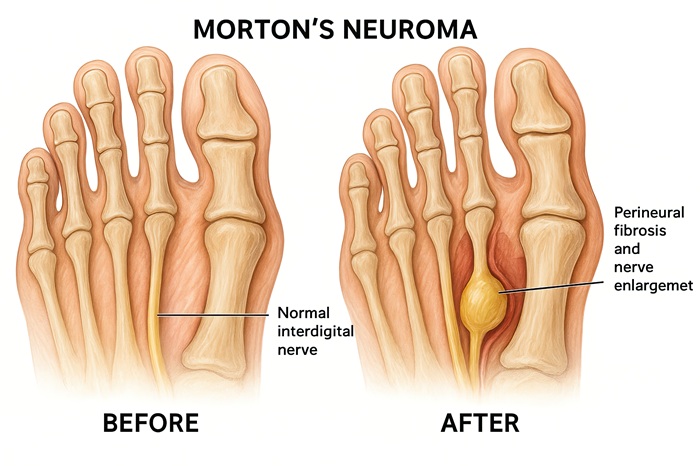
Morton’s neuroma is a painful irritation and thickening of a nerve in the ball of the foot, most often between the 3rd and 4th toes, and is essentially a type of compressive neuropathy. It behaves like a “pinched nerve” from repeated pressure and friction rather than a true tumor. Studies suggest that neuroma-like changes on imaging can appear in people without symptoms, which is why your story and exam are as important as any scan.
Common symptoms
People with Morton’s neuroma often feel burning pain in the ball of the foot that can shoot into the toes, sometimes with tingling or numbness. Many describe it as walking on a small pebble, a wrinkled sock, or a bruise under a very specific spot in the forefoot. Symptoms usually worsen in tight or high-heeled shoes and ease when shoes come off, the toes are spread, or the foot is massaged. In one MRI study, neuroma-like findings were seen in about 33% of feet that did not actually have clinical neuroma symptoms, underscoring how similar issues can mimic each other.
Who is at risk?
Morton’s neuroma is much more common in women than men; some clinical sources report at least a five-fold higher incidence in women, likely tied to narrower, higher-heeled footwear and forefoot loading patterns. Repetitive forefoot impact sports, sudden increases in standing or walking time, and jobs that keep you on your feet for hours all add mechanical stress to the nerve. Foot structure (such as a very high arch or flat foot) and prior forefoot injuries can also change how pressure is distributed and make the nerve more vulnerable.
Meet Our Specialists

Trung Ha, MD

Raphael Ye, DO

Yasmin Fatemi, MD

Brian Lee, DC

Stephanie Yianitsas, PA-C
How It’s Diagnosed at Holistiq
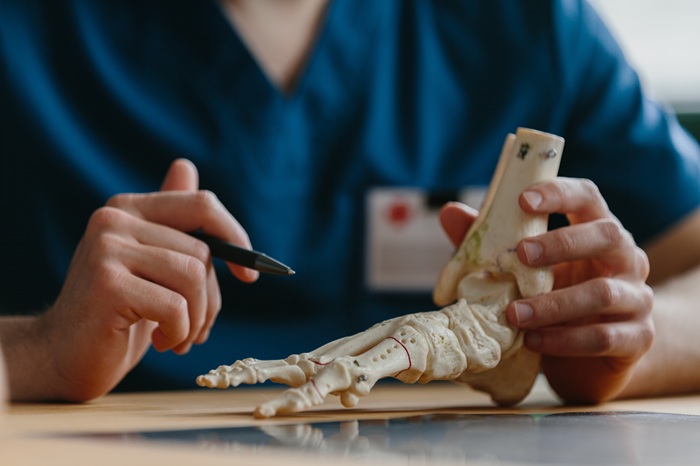
Your visit starts with a focused conversation about exactly where your pain is, what it feels like, and what makes it flare. A hands-on exam then stresses the suspected nerve while checking neighboring joints, tendons, and the plantar plate so other causes of forefoot pain are not missed. When imaging is helpful, ultrasound or MRI can be ordered; a meta-analysis reported ultrasound sensitivity around 0.91 and MRI sensitivity around 0.90 for identifying Morton’s neuroma when compared with surgical findings. In some cases, a small diagnostic injection can further confirm that the irritated nerve is the main pain generator.
Conservative treatment options
Most people start with non-surgical care aimed at reducing compression, improving mechanics, and quieting the irritated nerve.
Shoe changes
Wider toe boxes, lower heel drop, and more forgiving forefoot materials to stop squeezing the nerve.
Orthotics and pads
Custom or prefabricated devices, including metatarsal pads or bars, to shift pressure away from the painful space.
Physical therapy
Targeted flexibility, foot strength, balance, and gait retraining to reduce overload on the affected interspace.
Injections
Carefully placed corticosteroid injections can reduce inflammation and pain for appropriate candidates.
Activity modification
Short-term adjustments in walking/running volume, impact, and surfaces to allow healing while maintaining overall fitness.
Nutrition and recovery support
An anti-inflammatory nutrition strategy and recovery habits to support tissue healing and nerve health, used alongside mechanical offloading.
Because imaging can show neuroma-like changes even in people without symptoms (about one-third of asymptomatic feet in one MRI series), treatment at Holistiq is guided primarily by your clinical picture—how you feel, move, and respond to targeted tests—rather than imaging alone.
Advanced Options When Needed
If thorough conservative care doesn’t provide enough relief, more advanced interventions may be discussed. These options depend on how severe and limiting your symptoms are, what imaging shows when used, and how you responded to earlier treatments. The goal is always to balance durable pain relief with preserving as much natural foot function and sensation as possible, only escalating when simpler options have been fully explored.
When to Call Holistiq
You should contact Holistiq if forefoot burning, tingling, or “pebble in the shoe” pain is limiting your walking or workouts, if numbness is progressing, or if symptoms persist beyond a couple of weeks despite wearing wider shoes. It’s also important to be seen if you’ve started limping or changing the way you walk to avoid pain, since this can set off problems in your knees, hips, or back.
FAQs
Is Morton’s neuroma really just a “pinched nerve”?
Yes, in everyday terms that’s a reasonable description—it’s a compressed, irritated nerve in the ball of the foot, not a cancerous growth.
Can a scan show a neuroma even if I don’t hurt?
Yes. One MRI study showed Morton’s neuroma-like lesions in roughly 33% of feet without clinical neuroma symptoms, which is why imaging is always interpreted in context.
Which is better: ultrasound or MRI?
A meta-analysis found that both tests are similarly accurate for detecting Morton’s neuroma, with ultrasound sensitivity about 0.91 and MRI about 0.90 when compared with surgical confirmation. Choice often comes down to what you and your clinician need to see, availability, and cost.
Who gets Morton’s neuroma most often?
It’s commonly reported in middle-aged women, with some data suggesting women are affected at least five times more often than men. This is likely due to a mix of footwear style, activity patterns, and foot structure differences.
Will I automatically need surgery?
No. Many patients improve significantly with footwear changes, offloading, rehab, and—when appropriate—targeted injections, and interventional procedures are generally reserved for stubborn, function-limiting cases.
Ready for Clarity and a Plan?
Schedule a Morton’s neuroma evaluation at Holistiq to confirm what’s really driving your pain and build a personalized, conservative-first treatment plan—with advanced options available if you need them.
Where Does It Hurt? We Can Help.